State Connect: Traffic Control
- 3.7
- Rating
- 10.00M
- Installs
- Free
- Price
 Analysis by App-foxy
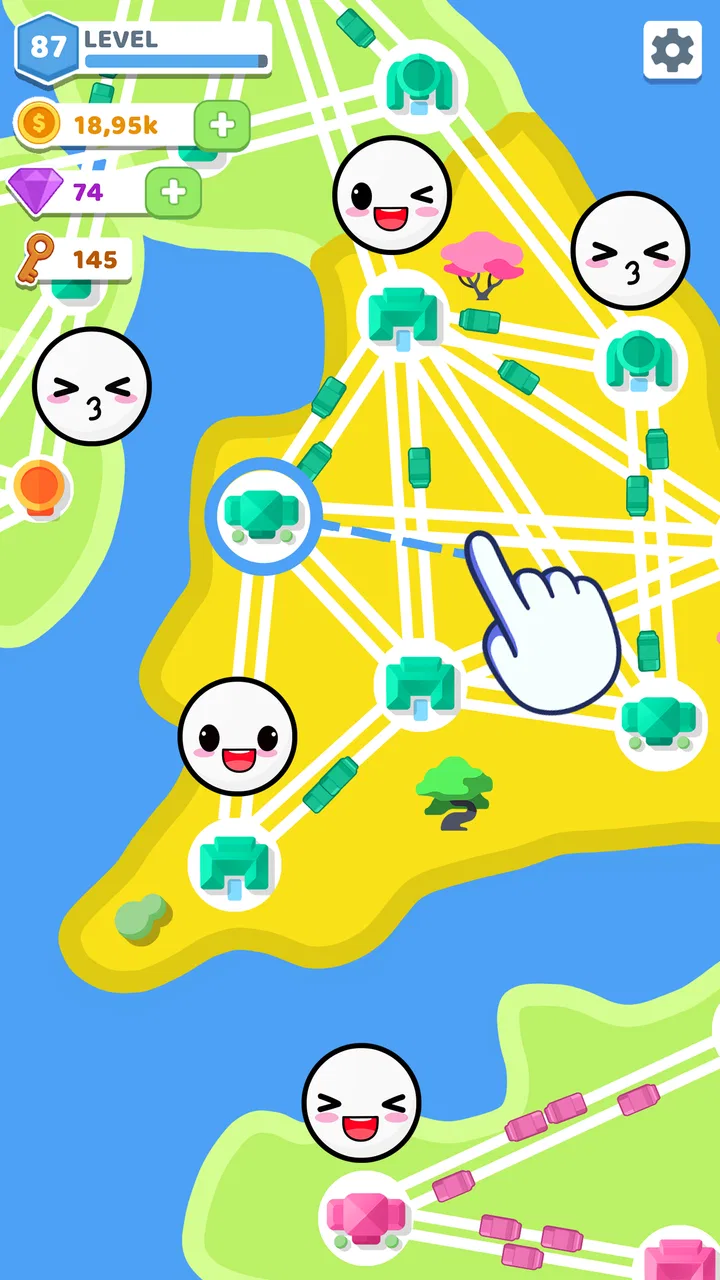
Managing a growing road network sounds simple until several streams of cars begin competing for the same junction. State Connect: Traffic Control turns that problem into a casual puzzle about building roads and cities while keeping traffic moving. I found its central idea easy to understand but surprisingly effective: instead of racing, fighting, or collecting complicated resources, I focus on connecting places and preventing the road system from becoming overwhelmed.
That makes it a comfortable game to pick up for a short break. It is free to download, suitable for Everyone, and developed by CASUAL AZUR GAMES. The game belongs to the casual category, but its appeal comes from giving a little more responsibility than a purely passive time-killer. Every new connection changes how vehicles flow, so even a small decision can create a smoother route or a frustrating bottleneck.
After spending time with it, I would describe the experience as a light traffic-management puzzle rather than a full city-building simulation. It does not ask me to design an entire urban economy or learn a long list of systems. Instead, it keeps bringing my attention back to one question: can I build a road layout that lets traffic reach its destination without collapsing into congestion?
You May Also Like

 Blood Strike: 2.5 Anniversary
Blood Strike’s Loadouts Turn Every Drop Into a Tactical Gamble
A close look at Blood Strike’s custom loadouts: how fast access to signature weapons reshapes its battle royale rhythm, rewards preparation, and narrows the gap between fights.

 Pandora - Music & Podcasts
Pandora’s Music Is Easy to Start, but Harder to Recover
Pandora’s strength is its low-effort path from a seed to a station. Its weak spot is how much confidence it asks you to place in connection, setup, and quiet recovery.

 8 Ball Pool
 Is Built on Rivalries, Rematches, and Routine
A close look at the rivalries, rematches, shared routines, and unanswered safety questions that turn a quick pool match into a persistent mobile community.

 Samsung Music
’s Quiet Strength Is Playing What You Already Own
Its reach comes less from spectacle than from dependable access to a personal library. That simplicity is both the app’s strongest retention engine and its ceiling.

 AccuWeather: Weather Radar
AccuWeather Review: A Quick, Clear Forecast for Everyday Decisions
For everyday plans, the best forecast is the one you can understand quickly. AccuWeather makes rain timing, radar, and local conditions easy to act on, with a few trade-offs.

 Hill Climb Racing
Why Hill Climb Racing Still Turns Crashes Into One More Run
A tiny car, a bumpy hill and one more upgrade: Hill Climb Racing keeps resurfacing because its simple chaos makes every near-miss feel personal.
More From Our News Desk



Why road building is the real challenge
The most important capability is the ability to shape roads and cities while managing vehicle movement. That combination gives the game its identity. If it were only about placing roads, the decisions would feel decorative. If it were only about watching traffic, I would have little control. Here, construction and traffic control are tied together, so the road I create immediately affects the practical result.
I like that this creates a clear cause-and-effect loop. A route may look efficient when viewed on its own, yet become awkward once more vehicles use it. A direct connection can save distance but concentrate too much traffic in one place. A less obvious route may distribute movement more comfortably. The game encourages me to look at the whole network instead of treating each road as an isolated object.
This is also why the experience works better than the store summary might suggest. The appeal is not simply “build roads, then watch cars.” The interesting part is deciding where a connection should begin, where it should finish, and whether it helps the wider layout. I often found myself making a change that seemed sensible, then reconsidering it after seeing how the rest of the traffic reacted.
The city-building element gives the road decisions a visible purpose. I am not drawing lines on an empty board with no context; I am trying to connect places in a developing environment. That makes progress easier to understand, especially for players who enjoy seeing a simple layout gradually become more organized. The presentation remains approachable, but the underlying task still rewards attention.
Reading the road network instead of reacting to one car
My most useful adjustment was to stop following individual vehicles too closely. One car can make a route look successful for a moment, but the better question is whether several vehicles can use the network without repeatedly interfering with one another. When I watched the broader flow, I made more reliable decisions and spent less time changing roads impulsively.
A practical habit is to pause mentally before adding another connection. I look at the busiest-looking area, identify where traffic is being funneled, and then ask whether a new road would relieve that pressure or simply attract more vehicles to the same point. This is not a complicated strategy, but it makes the game feel more deliberate and gives each placement a reason.
Another useful approach is to treat a road as part of a sequence. A connection might solve the first half of a journey while creating trouble at the next junction. Checking the complete path helps me avoid celebrating a short-term improvement that merely moves the congestion farther along. This is one of the game’s quiet strengths: it teaches network thinking without presenting itself as a serious simulation.
How the traffic control works in everyday play
In practice, the game is built around repeated decisions rather than a single perfect plan. I connect areas, observe the resulting movement, and adjust my thinking as the city develops. That rhythm makes it suitable for short sessions because I can understand the immediate objective quickly, yet it also gives me a reason to continue when I want to improve my layout.
The controls and general concept are accessible enough for casual players. I did not need a tutorial-heavy mindset to understand what I was trying to accomplish. The visual relationship between roads, destinations, and moving vehicles communicates most of the important information. That is valuable on a phone, where an overly detailed interface can make a simple game feel tiring.
Still, the simplicity does not remove all tension. Traffic management becomes less comfortable when several routes compete for space. At those moments, I have to decide whether to preserve a functioning connection, redirect movement, or accept that a temporary arrangement may need to be replaced. The game’s challenge comes from making those choices quickly enough to keep the network usable.
I found it helpful to make changes in small steps. Rebuilding too much of the layout at once makes it difficult to know which decision helped and which one caused a new problem. Changing one important connection, then watching the result, turns the experience into a series of readable experiments. This workflow is especially useful for new players who might otherwise keep rearranging everything without learning from the outcome.
The game also suits people who enjoy visual order. There is a modest satisfaction in seeing routes become cleaner and traffic move through them with fewer conflicts. That feeling is different from the reward structure of a conventional action game. There is no need to master fast reflexes; the pleasure comes from making a messy system more understandable.
A realistic short-session example
Imagine opening the game while waiting for a bus or taking a short lunch break. I can begin by checking the current road arrangement and identifying the connection that appears to carry too much movement. Instead of trying to redesign the entire city, I focus on one alternative route and watch whether it spreads traffic more evenly. If the result is better, I continue; if not, I have learned something without losing the whole session to trial and error.
That scenario reflects where the game feels most natural. It does not demand a long uninterrupted evening, and its central task is clear enough to resume after putting the phone down. At the same time, the traffic problem gives the session more substance than a game that only asks me to tap through repetitive rewards.
For younger players, the Everyone rating makes the concept approachable, while adults may appreciate the calm problem-solving. I would still avoid presenting it as a deep educational city simulator. Its lessons are informal and visual, and the main purpose is entertainment. The game is at its best when I want a gentle puzzle with a changing road layout, not when I want a detailed model of real transport planning.
The tradeoffs behind the simple design
The biggest advantage of the focused design is also its main limitation. Because the game centers so strongly on connecting roads and managing traffic, players looking for broad city customization may find the experience narrower than expected. I cannot approach it like a traditional construction game where every building, service, and budget decision becomes part of a large management system. The road network is the star, and everything else supports that idea.
That focus keeps the learning curve friendly, but it can also make the experience feel repetitive if I am not interested in optimizing routes. Players who prefer combat, character progression, story missions, or competitive multiplayer should probably choose a different casual game. This is a title for people who enjoy arranging systems and watching their decisions affect movement.
There is also a natural tension between experimentation and efficiency. Trying a new road can reveal a better solution, but it can also make the current layout less stable. I recommend treating failed arrangements as part of the process rather than expecting every placement to work immediately. The game is more enjoyable when I accept that traffic problems are feedback, not evidence that I have played badly.
The free entry point is convenient, especially for anyone who wants to test the concept before spending money. The game includes in-app purchases ranging from $0.99 to $19.99 per item, so players who prefer a completely purchase-free experience should keep that in mind. I would approach those options cautiously and first decide whether the basic traffic-control loop is enjoyable on its own. A purchase cannot make an uninteresting road puzzle become the right genre for you.
Performance expectations also depend on the device. The listed minimum operating-system requirement is Android 7.0, which makes the game accessible to many older Android phones, though the actual comfort of play will still depend on the hardware and screen size. On a smaller display, busy road layouts may require more careful visual attention. I found that the game is easiest to read when I resist rushing and examine the network before making a change.
The current version is 1.179, and the game has been available since September 9, 2021. Those details matter mainly because they place the title in the category of an established casual game rather than a brand-new experiment. Its audience is substantial: the store shows over ten million installs, alongside a 3.7 average from around one hundred thirteen thousand ratings and about eight thousand five hundred written reviews. I see that as a sign of broad interest, but not a guarantee that every player will enjoy the deliberately focused format.
Where it stands beside other casual choices
Compared with match-three games, this one asks for more spatial planning and less pattern recognition. Compared with idle games, it gives me more direct responsibility because the road layout matters. Compared with full city simulators, it is much easier to start and far less demanding, but it also offers a smaller management canvas.
That middle position is important. If I want something I can understand in seconds but still interact with thoughtfully, the traffic-control approach works well. If I want a large economy, detailed construction tools, or long-term character development, a deeper simulation would be a better choice. The game should be judged by how well it handles its single main idea, not by systems it never tries to include.
I also prefer it to many purely reflex-based casual games when I am tired. The pressure comes from recognizing a developing problem, not from tapping at maximum speed. However, someone who wants constant action may find the road-planning pace too quiet. The best alternative depends on whether you want to solve a network, clear a board, or simply watch progress accumulate.
Who benefits most from the traffic-focused format
I would recommend this game to players who enjoy tidy layouts, small strategic decisions, and visible consequences. It is particularly suitable for someone who wants a casual title that can be played in short bursts but still offers enough variation in road problems to encourage another attempt. The free price makes it easy to try, and the Everyone rating broadens its appeal for families looking for a straightforward mobile game.
It is also a good fit for people who like learning through experimentation. The most rewarding moments come from noticing why a route failed, changing one part of the network, and seeing a better flow emerge. That process gives the game more depth than its simple presentation initially suggests. My advice is to watch the network as a whole, change one connection at a time, and avoid building the most direct route automatically.
I would be more cautious about recommending it to players who dislike repetition or who expect a large collection of unrelated activities. The game’s charm depends on enjoying its central traffic puzzle. If connecting roads and correcting congestion already sounds dull, additional progress will not change that basic reaction. Likewise, players who want precise real-world traffic rules may find this too light and game-like.
For me, the strongest use case is a short, low-pressure session in which I want to solve a visual problem without committing to a complicated simulation. I can open it, make a few thoughtful changes, and leave with the satisfaction of having improved a small system. That is a more specific pleasure than generic casual entertainment, and it is exactly what gives the game its staying power.
State Connect: Traffic Control succeeds because it makes one capability—building roads that keep traffic moving—carry the entire experience. The concept is easy to enter, but the best results require patience, attention to the wider network, and a willingness to revise an attractive-looking route. I appreciate that balance: it is relaxed enough for everyday play, yet not so passive that my choices feel meaningless.
My final recommendation is positive for casual puzzle fans who want a traffic-themed challenge rather than a full city simulator. Try it if you enjoy organizing routes and learning from small mistakes. Skip it if you need story, action, deep customization, or a broad management system. As a free game from CASUAL AZUR GAMES, it offers a clear and approachable idea, and its real value comes from how satisfying it can feel to turn a crowded road network into one that finally works.
FAQs for State Connect: Traffic Control
01What is the main objective of State Connect: Traffic Control?
State Connect: Traffic Control is a strategic simulation game where the primary goal is to effectively manage and control traffic flow between various cities. Players are tasked with connecting states through roads, optimizing routes, and ensuring efficient transportation to prevent congestion and delays.
02Is State Connect: Traffic Control free to play?
Yes, State Connect: Traffic Control is free to download and play on both Android and iOS platforms. However, the game does offer in-app purchases for players who wish to enhance their experience with additional features, power-ups, or to remove ads.
03What kind of challenges can players expect in the game?
Players will encounter various challenges, including managing traffic congestion, optimizing road networks, and balancing city development. As the game progresses, the complexity increases with more cities to connect and higher traffic demands, requiring strategic planning and quick decision-making.
04Does State Connect: Traffic Control require an internet connection?
State Connect: Traffic Control can be played offline, allowing users to enjoy the game without an internet connection. However, certain features like leaderboards and in-app purchases may require connectivity to access the full range of functionalities.
05Are there any age restrictions for playing State Connect: Traffic Control?
State Connect: Traffic Control is suitable for players of all ages. The game's interface is user-friendly, making it accessible for younger audiences, while its strategic elements provide an engaging experience for older players. It’s a great educational tool to help develop planning and problem-solving skills.
Pros
- Intuitive user interface for easy navigation.
- Challenging levels keep players engaged.
- Visually appealing graphics enhance gameplay.
- Regular updates with new features and levels.
- No intrusive ads disrupting the experience.
Cons
- Limited offline play options available.
- Can be battery-intensive on older devices.
- Requires in-app purchases for some features.
- Occasional lag on lower-end smartphones.
- Sound effects can become repetitive.

State Connect: Traffic Control
Gallery